
Does Keller Gold & Silver Buy Dental Gold Crowns, Bridges and Partials with XRF Testing and Live Spot Rates
A small crown in a jewelry box can be worth more than it looks like. Dental gold often contains real precious metal, but it rarely comes stamped with a karat mark. That is why a proper test matters.
Keller Gold & Silver can evaluate many forms of dental gold, including crowns, bridges, and partials, using X-ray fluorescence testing to identify metal content. Payouts are then tied to live gold spot rates, the same market pricing system used across the precious metals trade.
The key point is simple: dental gold is valued for its actual precious metal content, not for its size, color, or original dental cost. A clean yellow-gold crown, a white-gold bridge, and a partial with gold alloy clasps may all have value, but the amount depends on purity, weight, and the current market price of gold.
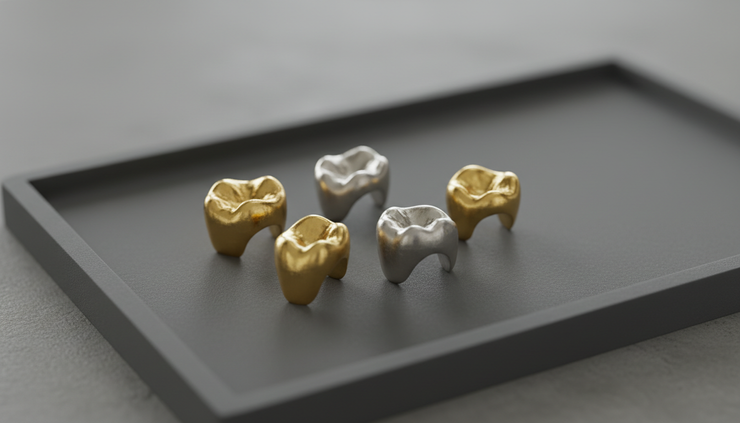
Keller Gold & Silver buys many common types of dental gold
Dental gold is a broad term. It can refer to gold crowns, bridgework, partial denture components, inlays, onlays, and other dental restorations made with precious metal alloys. These items may look very different from retail jewelry, but they can still contain recoverable gold.
Common accepted dental gold items include:
Yellow gold crowns
These are often what people picture first. They may appear bright yellow, deeper yellow, or slightly orange depending on the alloy mix.
White gold crowns
White dental alloys can contain gold along with metals such as palladium, platinum, silver, or other alloying metals. Color alone does not prove or disprove value.
Gold bridges
Bridges can include several joined units. Some may have porcelain fused over metal, while others may show exposed gold alloy.
Partials and partial denture components
Some partials include gold alloy frameworks, clasps, or connectors. Others may be made from non-gold metals, so testing is the only reliable way to know.
Dental scrap
This can include broken crowns, cut bridge sections, old dental work saved after removal, or loose pieces recovered after dental treatment.
Keller Gold & Silver does not need an item to look new or attractive. Dental gold is generally treated as scrap precious metal. Scratches, tooth cement, porcelain, or age may affect handling and weight, but they do not erase the value of whatever gold is present.
That said, not every dental-looking item contains gold. Some modern dental restorations are made from ceramic, zirconia, stainless steel, titanium, or base-metal alloys. A crown that looks white could be high-value precious alloy, or it could be mostly non-precious material. This is exactly why XRF testing is useful.
Dental gold purity usually falls between 10k and 18k
Gold purity is often expressed in karats. Pure gold is 24 karat, or 24k. Jewelry buyers are familiar with 10k, 14k, and 18k gold, and dental gold often falls in a similar range.
A practical purity range for many dental gold items is 10k to 18k, though individual pieces can test outside that range. Dental alloys are engineered for strength, corrosion resistance, and fit in the mouth. Pure 24k gold is too soft for most dental use, so it is mixed with other metals.
Here is how common karat levels compare:
Karat | Approximate pure gold content | What it means |
10k | 41.7% gold | Lower gold content, still legally gold in the U.S. jewelry trade |
14k | 58.3% gold | Common mid-range gold content |
16k | 66.7% gold | Sometimes seen in dental alloys |
18k | 75.0% gold | Higher gold content with strong precious metal value |
Dental alloys can be more complex than ordinary jewelry alloys. A bridge may contain gold plus palladium. A crown may include platinum-group metals. A white dental alloy may have a valuable precious metal mix even if it does not look yellow.
This is one reason visual guesses are risky. A heavy bridge with porcelain attached may contain less payable gold than expected because some of the weight is ceramic. A small yellow crown may test at a higher karat than a larger piece. The only fair method is to test the metal and calculate based on the results.
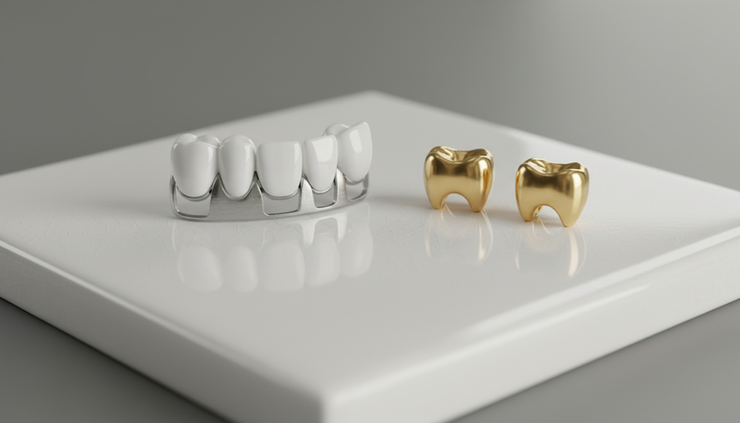
Certified XRF testing identifies the karat content
Keller Gold & Silver uses certified X-ray fluorescence, often called XRF testing, to determine the metal content of dental gold. XRF is widely used in precious metal buying, refining, manufacturing, and quality control because it can identify elements without melting or damaging the item.
The science behind XRF is well established. An XRF analyzer directs X-rays at the sample. The atoms in the sample emit secondary, or fluorescent, X-rays. Different elements produce different energy signatures, so the instrument reads which metals are present and estimates their percentages.
For dental gold, that matters because the item may include:
Gold
Silver
Palladium
Platinum
Copper
Zinc
Nickel
Other alloying metals
A typical XRF evaluation follows a practical sequence.
The item is visually inspected
The buyer first looks at the item to understand what is being tested. A single crown is straightforward. A bridge with porcelain, cement, and exposed metal may need more careful inspection. A partial may contain several materials, not all of which are precious.
The analyzer reads the exposed metal
The XRF test works best when the instrument can read clean, exposed metal. Porcelain, resin, tooth material, glue, and debris can interfere with the reading if they cover the alloy. In some cases, the buyer may test more than one spot, especially if the item appears to have mixed materials.
The karat estimate is based on the gold percentage
Once the analyzer reports the gold percentage, that number can be converted into an approximate karat level. For example, an item that tests around 58% gold is close to 14k. An item around 75% gold is close to 18k.
Dental alloys do not always line up perfectly with jewelry karat categories. A crown might test at 62% gold, which is between 14k and 15k. In that case, the actual percentage is more useful than a rounded label.
The non-gold materials are not treated as gold
XRF helps separate assumptions from facts. Porcelain is not gold. Cement is not gold. A base-metal backing is not gold. The payout should reflect the precious metal portion of the item rather than the total weight of everything attached to it.
This is one reason professional testing benefits both sides. The seller gets a clear basis for the offer. The buyer avoids guessing.

Payouts are calculated from live gold spot rates
The value of dental gold changes with the gold market. Keller Gold & Silver calculates payouts based on live gold spot rates, then adjusts for the tested gold content and the weight of the payable material.
The gold spot price is the current market price for one troy ounce of pure gold. Precious metals are usually priced in troy ounces, not standard household ounces. One troy ounce equals about 31.1 grams.
A simplified payout formula looks like this:
Payable value is based on metal weight, tested gold purity, and the current live spot price of gold.
For illustration, the math works like this:
The dental gold item is weighed.
Nonpayable material is considered, such as porcelain or cement.
XRF testing estimates the gold percentage.
The pure gold content is calculated.
The result is valued against the live gold spot rate.
The buyer applies the shop’s purchase rate or refining terms.
Here is a simple example using no fixed market price:
Step | Example calculation method |
Item weight | Metal-bearing portion is weighed in grams |
XRF result | Test shows the alloy is about 58.3% gold |
Karat equivalent | About 14k |
Pure gold estimate | Weight multiplied by 0.583 |
Market basis | Pure gold amount valued against live spot |
Final offer | Market value adjusted by the buyer’s payout rate |
This approach is more accurate than paying by appearance. A yellow crown that tests as 10k has less gold than an 18k item of the same weight. A white alloy that contains gold and palladium may have value that is not obvious to the eye. A bridge with porcelain may weigh more overall, but only the precious metal portion drives the payout.
Live spot pricing also means the offer can change as the market moves. Gold prices trade throughout the business day. If the spot rate rises, the melt value of gold-bearing dental scrap rises with it. If the spot rate falls, the value drops.
Gold payouts are financial transactions, so this article is informational only and not financial advice. A professional evaluation gives the most accurate current value for a specific piece.
What to bring when selling dental gold
Dental gold does not need to be polished or restored before evaluation. In most cases, it is better to leave the item as it is and let the buyer test it properly.
Useful steps before bringing in dental gold include:
Place small crowns or bridge pieces in a sealed bag or container.
Keep different items together if they came from the same dental work.
Do not scrape, file, or chemically clean the metal.
Bring any related pieces, even if they look broken or mixed with porcelain.
Make sure the item has already been removed by a dental professional.
Keller Gold & Silver evaluates dental gold as precious metal scrap. The shop is not a dental provider and does not remove dental work from the mouth. Any crown, bridge, or partial should be handled through proper dental care before it is brought in for metal testing.
Documentation is rarely the deciding factor because the XRF analyzer reads the metal directly. Still, if a dentist gave information about the alloy, it can be helpful context. The final offer should come from actual testing, weight, and the live market.
Why professional testing matters for dental gold
Dental gold is one of the harder forms of gold for a seller to estimate at home. Jewelry often has stamps such as `10K`, `14K`, or `18K`. Dental restorations usually do not. Even when two pieces look similar, their alloy content can differ.
Professional XRF testing solves three common problems.
The first is color. Yellow color suggests gold content, but it does not reveal karat. White color can hide precious metal content because white dental alloys may contain gold, palladium, or platinum.
The second is mixed material. Porcelain-fused crowns and bridges can contain valuable metal under ceramic. The ceramic adds weight but does not add gold value.
The third is alloy complexity. Dental metals are chosen for performance in the mouth. They are not always simple gold, silver, and copper blends like many jewelry items.
A transparent appraisal should connect the final offer to measurable facts:
The item’s weight
The XRF result
The gold percentage or karat equivalent
The live spot price
The buyer’s payout method
That fact-based approach is especially helpful for dental gold crowns and bridges because the true value is often hidden under porcelain, cement, age, or discoloration.
FAQ
Does Keller Gold & Silver buy old dental crowns?
Yes. Keller Gold & Silver can evaluate old dental crowns for gold content. The value depends on the tested alloy, the weight of the gold-bearing material, and the live gold spot rate at the time of the offer.
Are white dental crowns worth anything?
Some white dental crowns can have value. White dental alloys may contain gold, palladium, platinum, silver, or other metals. XRF testing is needed because some white crowns are non-precious ceramic or base-metal restorations.
What karat is dental gold?
Dental gold commonly falls between 10k and 18k, but the exact purity varies by alloy. Because dental gold is rarely stamped, XRF testing gives a more reliable purity reading than appearance.
Can porcelain attached to a bridge be sold as gold?
Porcelain itself has no gold value. If a bridge has precious metal under or around the porcelain, that metal can be evaluated. The payout is based on the gold-bearing material, not the total weight of porcelain and cement.
How does the live gold spot rate affect my payout?
The live spot rate sets the current market value of pure gold. Once the item’s gold content and weight are known, the payout is calculated from that market value and the buyer’s purchase rate.
The takeaway
Keller Gold & Silver buys and evaluates many forms of dental gold, including yellow and white gold crowns, bridges, partials, and related dental scrap. The most reliable offers come from certified XRF testing, not visual guesses.
Dental gold commonly tests in the 10k to 18k range, though every piece is different. Once the gold percentage is known, the payout can be calculated using the item’s weight and the current live gold spot rate.
If a crown, bridge, or partial has been sitting unused, it may be worth having it tested. The item does not need to look perfect. It only needs recoverable precious metal content, measured clearly and valued against the market.
Comments