
Selling Gold in Keller Texas Local Tips Market Trends and Prep Advice
Gold can be surprisingly easy to sell, but it is just as easy to accept less than a fair offer if you do not know what you have. A broken chain, an old class ring, a single earring, or inherited coins may all carry value. The key is knowing how buyers price gold and how to compare local offers around Keller, Texas.
This guide walks through where to sell gold locally, what affects gold prices, how to estimate the value of your items, and how to prepare before walking into a shop. The goal is simple: help you make a calm, informed decision instead of feeling rushed at the counter.
This article is for general information only and should not be treated as financial advice.

Where to sell gold in Keller, Texas
Keller sits close to several North Texas retail and resale markets, so sellers often have more than one option. The best place depends on what kind of gold you have and whether you care more about speed, convenience, or the highest possible payout.
Reputable local jewelers
A trusted jeweler is often a good first stop for gold jewelry, especially if the piece may have resale value beyond melt price. For example, a well-made gold bracelet from a known designer may be worth more as jewelry than as scrap metal.
Look for jewelers that:
Test gold in front of you
Explain the karat and weight clearly
Separate diamonds, gemstones, or watches before quoting melt value
Provide a written or itemized offer
Have a long track record in the area
A jeweler may be especially helpful if you have inherited pieces and need to understand what is fine jewelry, what is scrap gold, and what might be better repaired or appraised.
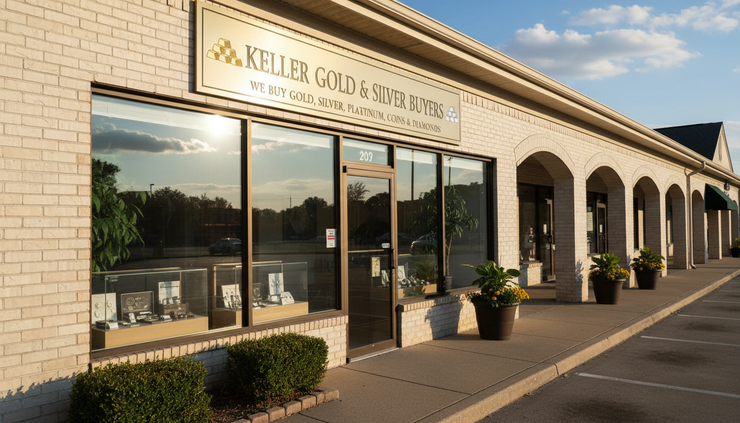
Gold and silver buyers
Dedicated precious metal buyers usually focus on the metal content. This can be useful for broken chains, mismatched earrings, dental gold, bullion, and coins with little collectible premium.
A good buyer should use clear testing methods. Common tools include a jeweler’s loupe, magnet, scale, acid test, and electronic precious metal tester. Some buyers may also use XRF testing, which reads metal composition without damaging the item.
When comparing gold buyers, ask how they calculate the offer. A clear answer should include:
The day’s spot price
The item’s karat
The exact gram or pennyweight measurement
The payout percentage
If the shop cannot explain these basics, keep shopping.
Pawn shops
Pawn shops can be convenient because they buy many kinds of items, not just jewelry. A pawn shop may be a practical choice if you want a quick sale or if you are also selling tools, watches, electronics, or other merchandise.
That said, pawn shops often price items with resale risk in mind. They need room for testing, storage, overhead, and resale. That does not mean a pawn shop offer is unfair, but it does mean you should compare it with at least one precious metal buyer or jeweler before accepting.
If you are considering a pawn loan instead of selling outright, read the terms carefully. A loan lets you reclaim the item if repaid on time, but fees and interest can add up.
Coin shops
If you have gold coins, do not assume melt value is the whole story. Some coins trade mainly for their gold content, while others may have numismatic value based on rarity, condition, mint mark, and demand.
A coin shop can help separate common bullion coins from collectible coins. For example, American Gold Eagles and Canadian Maple Leafs usually track close to the bullion market, although premiums can change. Older U.S. gold coins or foreign coins may need a more specialized review.
For coins, avoid cleaning them. Cleaning can reduce collector value, even when it makes the coin look brighter.
How gold market trends affect local offers
Gold prices move every trading day. Local buyers usually base offers on the spot price, which is the current market price for gold traded in large wholesale quantities. Spot prices are commonly quoted per troy ounce.
A troy ounce is not the same as a regular household ounce. One troy ounce equals about 31.1 grams. Gold buyers often weigh jewelry in grams or pennyweights, then convert that weight into a melt value.
Gold prices tend to respond to several broad forces:
Inflation expectations
Interest rates
Strength or weakness of the U.S. dollar
Central bank buying
Investor demand for safe-haven assets
Jewelry and industrial demand
According to widely followed global benchmarks, including futures markets such as COMEX and price references used by bullion dealers, gold has traded near historically high levels in recent years. That does not mean the price only rises. Gold can move sharply in both directions over weeks or months.
For sellers in Keller, the practical takeaway is simple. Check the spot price the same day you plan to sell. A quote from last month may not reflect today’s market.
How to evaluate the value of gold items
A gold item’s value starts with four factors: purity, weight, market price, and buyer payout. Knowing these makes it easier to understand an offer.
Check the karat mark
Gold jewelry in the U.S. is often stamped with a karat mark. Common marks include:
Mark | Gold purity | What it means |
10K | 41.7% gold | Common in durable everyday jewelry |
14K | 58.3% gold | Very common for U.S. rings and chains |
18K | 75.0% gold | Higher gold content, often used in fine jewelry |
22K | 91.7% gold | Common in some imported jewelry and high-purity pieces |
24K | 99.9% gold | Pure or nearly pure gold, often bullion |
A stamp helps, but it is not proof by itself. Clasps can be replaced, items can be mis-stamped, and plated pieces sometimes look convincing. A buyer should test the item before making a final offer.
Common non-solid-gold markings include `GP` for gold plated, `GF` for gold filled, and `HGE` for heavy gold electroplate. These items contain much less gold than solid karat jewelry and may have little scrap value.
Weigh the item correctly
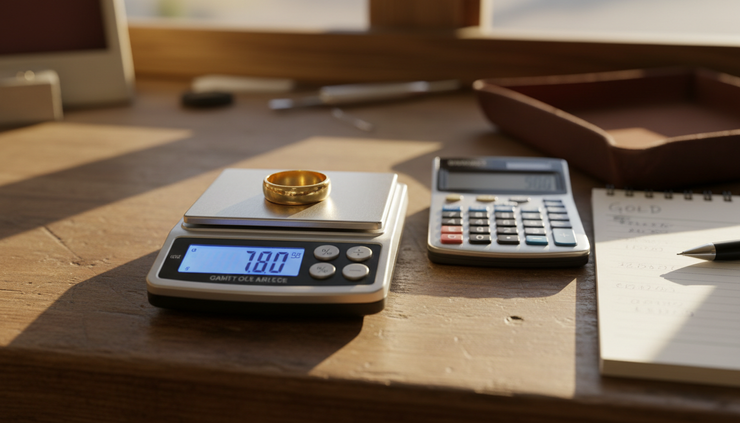
Gold value depends heavily on weight. If you have a kitchen scale, you can get a rough estimate in grams. A professional buyer should use a calibrated scale and weigh items by karat group.
Do not mix 10K, 14K, and 18K pieces into one pile when calculating value. Each purity level has a different actual gold content.
Estimate melt value with a simple formula
You can estimate the melt value of gold jewelry with this basic calculation:
Item weight in grams × gold purity × current gold price per gram = estimated melt value
For example, if a 14K bracelet weighs 10 grams, the pure gold content is about 5.83 grams because 14K is 58.3% gold. Multiply that gold content by the current gold price per gram.
The buyer’s offer will usually be less than melt value. That discount covers refining costs, market risk, testing, rent, labor, and profit. The best way to judge fairness is to compare multiple offers, not expect full spot price for scrap jewelry.
Separate scrap value from resale value
Not every gold item should be priced only as scrap. A signed designer piece, antique jewelry, a luxury watch, or a gemstone ring may deserve a different evaluation.
Before selling gold in Keller Texas, sort items into two basic groups:
Likely scrap
Broken chains, single earrings, bent rings, damaged charms, and plain pieces with no resale appeal.
Possibly resale-worthy
Designer jewelry, antique pieces, gemstone rings, collectible coins, watches, and items with original boxes or paperwork.
If a buyer immediately offers melt price for a piece that looks unusual or branded, get a second opinion.
How to compare offers without pressure
A fair gold sale should feel clear, not rushed. Most reputable buyers understand that sellers want to compare offers.
Start with two or three local quotes if the items are valuable enough to justify the time. Keller residents may compare shops in Keller, Southlake, Fort Worth, Watauga, North Richland Hills, and nearby areas, depending on convenience.
When you visit, ask direct questions:
What karat did each item test as?
What weight did you record?
Are you paying by gram, pennyweight, or troy ounce?
What spot price are you using today?
What percentage of melt value are you offering?
Are gemstones or non-gold parts included or removed from the quote?
Be cautious if a buyer gives only a single lump-sum number and will not explain it. A clear breakdown makes it easier to compare offers fairly.
Watch for common red flags
Most local buyers operate honestly, but caution helps. Walk away if you notice:
Pressure to sell immediately
Refusal to return items after testing
Unclear weighing practices
Testing done out of view without explanation
Offers that change after you hesitate
Confusion between grams and pennyweights
Pennyweight is a valid jewelry trade measurement, but it can confuse sellers. One pennyweight equals about 1.555 grams. If one buyer quotes by gram and another by pennyweight, convert the numbers before comparing.
How to prepare gold before selling
Preparation does not need to be complicated. A little organization can help the buyer evaluate items faster and help you avoid mistakes.
Clean jewelry gently
Gold jewelry does not need to look brand new, but dirt and lotion can hide details. Use a mild approach:
Mix warm water with a small amount of gentle dish soap.
Soak solid gold jewelry for a few minutes.
Use a soft toothbrush to remove grime around settings or links.
Rinse carefully.
Dry with a soft cloth.
Do not use harsh chemicals, abrasives, or ultrasonic cleaners unless you know the stones can handle them. Pearls, opals, emeralds, and some treated gemstones can be damaged by aggressive cleaning.
For coins, do not clean them at all. Wiping, polishing, or dipping coins can scratch the surface and reduce collector value.
Gather documentation
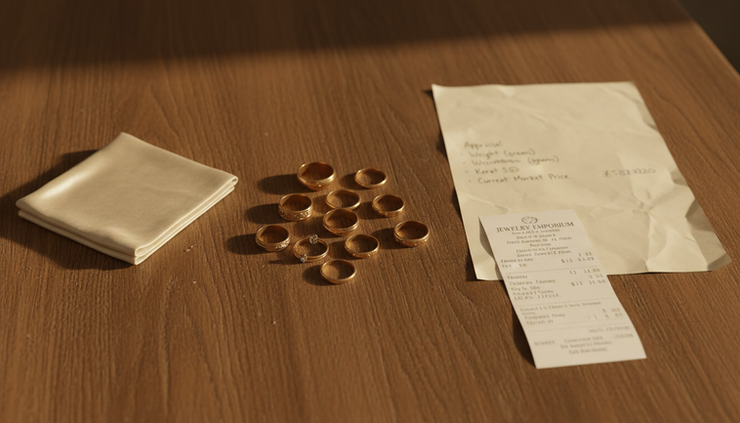
Paperwork can make a difference, especially for higher-value items. Bring anything that helps verify what you have:
Original receipts
Appraisals
Grading reports for coins or diamonds
Boxes, pouches, or certificates
Repair records
Any notes from an estate inventory
An appraisal does not guarantee a resale price. Insurance appraisals often reflect replacement cost, which can be higher than resale value. Still, documentation can help identify designer items, gemstones, and coin details.
Remove non-gold items from the decision
Keep sentimental items separate until you are sure you want to sell. If a ring has family meaning, do not bring it in the same bag as scrap jewelry unless you are emotionally ready to part with it.
Also check pockets, boxes, and clasps for small items. It is easy to overlook a pendant attached to a chain or a loose stone in a jewelry case.
Bring identification
Gold buyers and pawn shops commonly require a valid government-issued photo ID. Local and state rules for secondhand goods are designed to reduce theft and help law enforcement track stolen property. Requirements can vary, so bring ID even if you are only getting a quote.
The best time to sell gold
There is no perfect time that works for everyone. Trying to predict the top of the gold market is difficult, even for professionals.
A practical approach is to sell when three things line up:
The spot price is acceptable to you
You have compared local offers
You are sure you no longer want the item
If gold prices have risen and the item sits unused, selling may make sense. If the piece has sentimental value or could be worth more as jewelry, take more time.
For large amounts of gold, consider selling in stages. That reduces the risk of picking a single bad day in the market. For a small amount, the difference from day to day may be less important than finding a buyer who explains the offer clearly.
Quick checklist before you sell
Use this simple checklist before visiting a Keller-area buyer:
Sort items by type, such as jewelry, coins, bullion, and watches
Look for karat stamps and brand marks
Weigh items at home for a rough estimate
Check the current gold spot price
Gather receipts, appraisals, and certificates
Clean jewelry gently, but do not clean coins
Visit more than one buyer when the value is significant
Ask for a written or clearly explained offer
Take your time before accepting
Frequently asked questions
How much below spot price should I expect for gold jewelry?
Scrap gold jewelry usually sells for less than spot because the buyer must account for refining, testing, labor, and resale risk. The exact percentage varies by buyer, karat, item type, and market conditions. Comparing two or three offers is the best way to judge whether a quote is fair.
Is 14K gold worth selling?
Yes, 14K gold is commonly sold because it contains 58.3% pure gold. Its value depends on weight and the current gold price. A heavy 14K chain can be worth much more than a small 18K charm because weight matters as much as purity.
Should I sell gold coins to a jewelry buyer or coin shop?
If the coin is common bullion, a gold buyer or coin shop may both be able to quote it. If the coin is older, rare, graded, or unfamiliar, a coin shop is often the better first stop because collector value may exceed melt value.
Can I sell broken gold jewelry?
Yes. Broken chains, damaged rings, and single earrings are often bought for their melt value. The buyer will test the karat and weigh the gold content rather than focus on whether the piece is wearable.
Do I need an appraisal before selling gold?
Not always. For scrap jewelry, a professional buyer can usually test and weigh the item without an appraisal. For designer pieces, antique jewelry, gemstones, luxury watches, or collectible coins, an appraisal or specialist opinion may help you avoid underselling.
A confident sale starts with clear information
Selling gold locally should not feel mysterious. Once you understand karat, weight, spot price, and buyer payout, the process becomes much easier to judge.
For most Keller sellers, the smartest path is to sort items at home, check the current gold market, clean jewelry gently, gather any paperwork, and compare offers from reputable local jewelers, gold buyers, pawn shops, or coin shops. A fair buyer will explain the numbers, answer questions, and give you space to decide.
The best sale is not always the fastest one. It is the one where the price makes sense, the process feels transparent, and you walk away knowing you made an informed choice.


Comments